
Mi Bella Mondo

What to Expect on your Gorilla Trek(Tracking)

Everything You Need to Know before you step into Bwindi Impenetrable Forest

Gorilla trekking isn’t like a typical safari where you observe animals from the comfort of a vehicle. This is an immersive, on-foot adventure through one of Africa’s most challenging and beautiful forests. Here’s exactly what to expect, how to prepare, and what you need to know to make the most of your experience.

The Day Starts Early

Meeting at the Gate

Your day begins around 7:00-7:30 AM at one of Bwindi’s sector headquarters: Buhoma, Ruhija, Rushaga, or Nkuringo. As you arrive, you’ll immediately feel the energy—guides preparing, porters waiting to be hired, and fellow trekkers buzzing with excitement.

The Welcome Performance

Before any briefing, you’re treated to something special: a traditional welcome performance by locals. Drums, singing, colorful dancing—it’s joyful, vibrant, and a beautiful reminder that this experience isn’t just about the gorillas. It’s about the people who protect them and the communities that surround the forest.

The Briefing by Uganda Wildlife Authority (UWA)

After the performance, the Uganda Wildlife Authority rangers gather everyone for a mandatory briefing. This is where you learn the rules, safety procedures, and what to expect. Here’s what they cover:

Family Assignment You’ll be assigned to a specific gorilla family based on your fitness level and the family’s current location. Some families are close (a 30-minute to 1-hour hike), while others require 4-6 hours of trekking through challenging terrain.

Rules for Behaving Around Gorillas:

Stay Quiet – Avoid loud noises and sudden movements. Use a low voice if you need to talk.

Keep Your Distance – Stay at least 7 meters (23 feet) away from the gorillas at all times. (Note: In the dense forest, this is often impossible as gorillas move freely. The guides handle this carefully, but remember—these are wild animals, and they don’t always respect the 7-meter rule!)

Avoid Mimicking Their Sounds – Gorillas communicate through vocalizations. Imitating them may be interpreted as a threat or challenge.

No Eating or Drinking Near Them – Human food and germs can harm gorillas. Keep all food and water packed away.

No Flash Photography – Flash can startle and upset the gorillas. Turn off your flash before entering the forest.

Eye Contact is OK—But Read the Room – Brief eye contact is usually fine and can even be charming. But if a gorilla looks uncomfortable or stares back intensely, look down to show submission and respect.

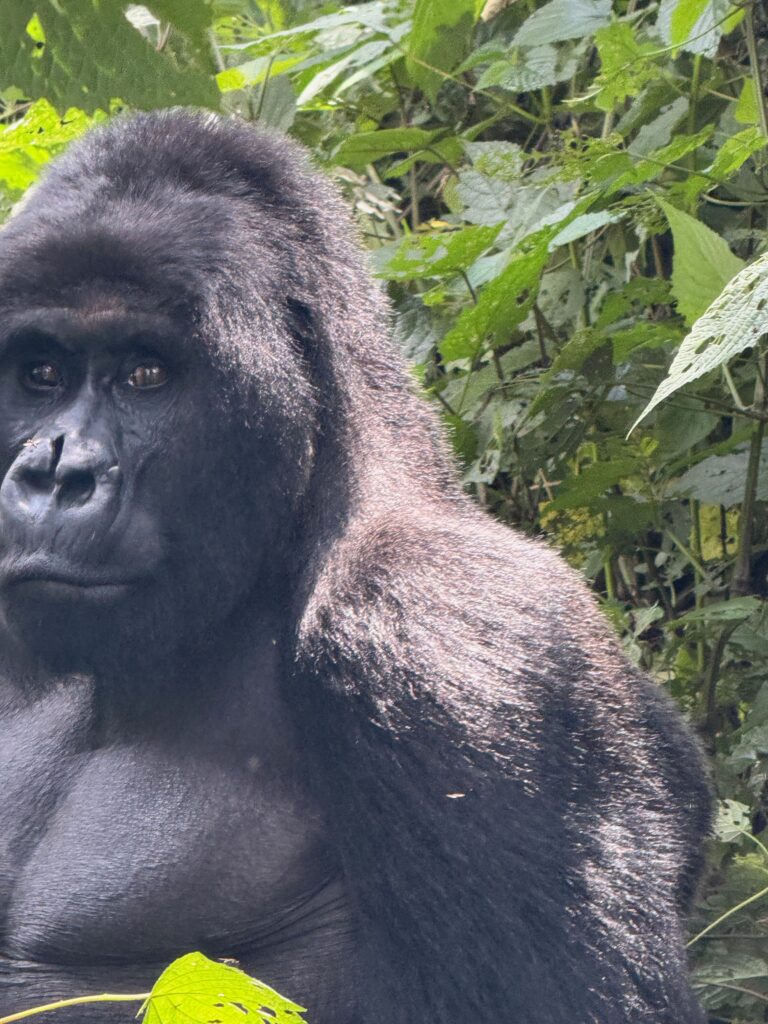
Personal Note: I had the privilege of making eye contact with a gorilla. His eyes were deep and dark brown, and for a moment, it felt like he was looking into my soul. And then, I swear, he smiled. Or at least, I like to think he did!

Always Follow Your Guide’s Instructions – Your guides and trackers know these gorillas and this forest intimately. Listen to them at all times.

Personal Note: One member of my group slipped and fell closer to a gorilla. The gorilla screamed—LOUD. It was startling and a powerful reminder that these are wild animals deserving of space and respect

Meeting Your Team and Hiring a Porter

After the briefing, you meet your tracking group (usually up to 8 people per gorilla family) and your guide. This is also when you can hire a porter.

Why You Should Hire a Porter

Hiring a porter is one of the most thoughtful decisions you can make. Here’s why:

For You:

  • Your hands are free, so you can focus on the hike and your footing
  • You have someone to help you navigate tricky terrain
  • They literally extend a hand (or stick) when you need help going uphill or downhill

For Them:

  • Porters work on a rotation schedule, sometimes just once or twice a month
  • This is a vital source of income for them and their families
  • Your hire directly supports the local community

Cost: $20 flat fee + $2-$5 tip for good service

Personal Note: I was paired with Sarah, and she was terrific. She carried my bag, helped me navigate slippery slopes, and literally extended a hand as I went downhill. Hiring her wasn’t just practical—it felt meaningful. She deserved every dollar I gave her.

Pro Tip: Use the Bathroom Before You Leave

There are bathrooms at the gate. Use them. If nature calls during the hike, there are ways to handle it in the woods (your guide will discreetly help), but it’s best to avoid it if possible.

The Journey to the Starting Point

From the gate, you’ll drive to the actual starting point of your trek. This drive can take anywhere from 15 minutes to over an hour, depending on which gorilla family you’re tracking and where they were last seen.

Personal Note: We drove about 45 minutes on bumpy African roads. In distance, it was only three miles, but on those roads, time moves differently.

The Trek: What It’s Really Like


The First Part: Reaching the Forest

The first part of the hike is usually fairly manageable—steady walking through villages or farmland until you reach the forest boundary. For many trekkers, this involves crossing a wooden bridge over a river. That river marks the transition. On one side, the village. On the other hand, the forest.

Once you cross it, you’re officially in Bwindi.

The Forest: Why It’s Called “Impenetrable”

And then everything changes.

Bwindi is called “Impenetrable” for a reason. The vegetation is thick, tangled, and relentless. The slopes are steep, often muddy, and covered in layers of vines, giant ferns, ancient trees, and mist that never fully clears.

You’re not walking on a clear trail. The trackers lead the way with machetes, cutting a path through the undergrowth as you go. You duck under branches, step over roots, push through leaves taller than you are (or taller than me, at least!).

The terrain is challenging:

  • Steep switchbacks that test your stamina
  • Muddy slopes that can be slippery
  • Uneven ground with exposed roots and rocks
  • High humidity that makes you sweat even when you’re not exerting yourself

The guides keep a steady pace, taking breaks occasionally, but it’s still a serious workout.

Personal Note: Thank goodness for Sarah. She helped me navigate the downhill sections, which were honestly scarier than the uphill ones. It’s wet. It’s slippery. And if you’re not careful, you’ll fall.

How Fit Do You Need to Be?

This is the question everyone asks, and the honest answer is: it depends.

Bwindi offers treks at different difficulty levels: easy, medium, and hard.

Easy Trek: For people with limited mobility or those who can’t handle forest terrain, a gorilla family is located very close to the meeting place. This requires only a few steps and minimal hiking. It’s an excellent option for elderly travelers or those with physical limitations.

Medium Trek: This is what I chose. At first, I wanted the tough track, but everyone talked me out of it. Looking back, I’m glad they did. The medium trek was tough enough.

What “medium” looked like for me:

  • About 2-3 miles of hiking before reaching the forest boundary
  • 1+ hours of steep, muddy, challenging terrain inside the forest
  • Relentless switchbacks across hillsides
  • Wet, slippery, uneven ground

Difficult Trek: For serious hikers. You venture deeper into the forest, hike much longer (sometimes over 6 hours), and face more challenging terrain. The reward? A more remote, personal experience with the gorillas.

My Best Advice: Go for some hikes before you arrive. Build your stamina and practice on uneven, hilly terrain if possible. This isn’t a casual walk—it’s a serious trek. But it’s also an incredible adventure, and every step is worth it.

When You Reach the Gorillas

After what feels like both forever and no time at all, the trackers—who have been following the gorilla family since dawn—signal that you’re close.

This is when things get real.

The Final Approach

At this point, you’re asked to:

  • Wear your mask (to protect the gorillas from human germs)
  • Leave all your belongings with the porters, who remain on the main path

Then, you follow the trackers off the trail and into the thick overgrowth. This is why it’s called the Impenetrable Forest. The vegetation is so dense that a person with a machete leads the way, clearing a path as you go. You duck under branches, step over roots, and push through leaves.

And then, suddenly, they appear.

One Hour with the Gorillas

You get one hour with the gorillas. Sixty minutes. It sounds brief, but when you’re standing there, surrounded by these incredible creatures, time seems both endless and fleeting.

The gorillas go about their day as if you’re not there. They munch on leaves, groom each other, play, rest, poop, and pee. The forest is quiet except for their soft chewing and the occasional click of cameras.

Every moment is extraordinary. Watching their movements, hearing their breath, seeing the kindness in their eyes—it’s humbling in a way that’s hard to describe.

Personal Note: At one point, a gorilla looked straight at me. His deep, dark brown eyes locked onto mine—steady, curious, impossibly human. For a heartbeat, the whole forest seemed to go quiet. It felt as though he was acknowledging me, saying hello in the only language we shared. I’m convinced he smiled. And yes, I even managed to capture a selfie with him. It’s a moment that will stay with me forever.

What to Wear: The Essential Gear

The forest is beautiful and very muddy. Expect thick vegetation, wet ground, steep slopes, and unpredictable weather. Dressing correctly makes the trek far more comfortable.

Footwear

Sturdy, non-slip hiking boots are essential. The trails can be slick, especially after rain, and you’ll be climbing over roots, rocks, and uneven terrain. Your boots should have good ankle support and deep treads.

Gaiters

Bring gaiters—your pants will get wet and muddy, and gaiters help keep the mud out. Our guide even slipped on what looked like simple plastic coverings, and they worked surprisingly well.

Gloves

Yes, bring gloves. Vegetation can sting or irritate your skin. Someone in our group brushed against a leaf, and his hands immediately turned red. Gloves protect you from both plants and the occasional need to grab onto branches while climbing.

Rain Gear

A lightweight rain jacket is essential, even if it isn’t raining. The forest creates its own weather, and the humidity can be unpredictable. Look for something breathable and waterproof that you can easily stuff into your daypack.

Pro Tip: Even if it doesn’t rain, the forest is naturally damp. Leaves drip, humidity clings to everything, and the ground is perpetually moist. Embrace it—it’s all part of the experience.

Trekking Poles

I brought a pair of trekking poles, but I only needed one. Honestly, you can skip buying them unless you plan to use them throughout your trip. The rangers will provide a wooden walking stick that works perfectly for the trek.

Long Pants and Long Sleeves

Wear long pants and a long-sleeved shirt to protect your skin from vegetation, insects, and the sun. Lightweight, quick-dry fabric works best.

Layers

The forest can be cool in the morning and warm once you start hiking. Dress in layers that you can easily remove and pack away.

Hat and Sunscreen

Even in the forest, you’ll have moments in the sun. Bring a hat and sunscreen.

And Don’t Stress Too Much

If you forget something, don’t worry. You’ll be muddy, sweaty, and gloriously dirty by the time you leave the forest anyway. That’s part of the adventure and part of the story you’ll carry home!

Tipping Guidelines: Who to Tip and How Much

Tipping in Uganda is customary and appreciated. It’s a great way to show gratitude to those who go above and beyond to make your experience memorable. However, be aware that many people expect tips, and navigating this can be challenging.

Here’s a guideline on who you’re expected to tip on the day of your gorilla trek so that you can bring enough cash:

  1. The Guide—$5-$15 per person per day

This is the person leading you up the mountain in search of the gorilla trackers. A good guide is a wealth of information, pointing out wildlife, plants, and sharing stories about the forest and the gorillas.

  1. The Trackers—$5-$10 per person per day

These are the unsung heroes who ensure you get to see the gorillas. They’ve been following the family since dawn, clearing paths with machetes so you can access the gorillas. Usually, several trackers accompany each family (we had 3). You can tip them individually or give the total to the lead tracker and ask them to distribute it.

  1. The Rangers—$5 per person per day

These are the armed guards who protect you from large mammals in the forest, such as elephants and buffalo. They’re the ones carrying the guns, ensuring your safety during the trek.

  1. Porters—$20 flat fee + $2-$5 tip

Porters carry your daypacks loaded with cameras, water, and food. They charge a $20 flat fee, and any extra tip is appreciated if they’ve provided exceptional service.

Personal Note: Sarah went above and beyond to help me navigate the mountain, and she clearly deserved every additional dollar I gave her.

A Word of Caution

If you’re reading this and thinking, “Damn, that’s a lot of tipping!” you’re not wrong. We were only advised to tip the guide and pay the porters $20 each, so we didn’t have nearly enough cash, which was pretty embarrassing!

However, it’s important to remember that tipping is not mandatory. You should only tip when you receive good service and feel the work was well done. The tip amount should also reflect the quality of service provided.

What Currency Should You Tip In?

USD is widely accepted throughout Uganda, and most guides and porters are happy to receive tips in dollars. However, it’s always better to tip in the local currency—Ugandan Shillings (UGX).

Why?

  • The money goes further for them
  • They can use it instantly instead of needing to travel to a currency exchange bureau
  • It shows respect for the local economy

Pro Tip: Carry a mix of USD and UGX. You can keep small denominations on hand to tip appropriately without fumbling for change after an emotional, exhausting day.

When is the Best Time of Year to See Gorillas?

The best time to visit is during the dry seasons:

  • June to August
  • December to February

I went trekking during the last week of November, and there was no rain! However, it’s important to remember that Bwindi is a rainforest, and rain can happen at any time of the year. During the dry season, the chances of rain are much lower but not zero.

The hike remains wet and muddy even during the dry season. The ground stays moist, the forest is naturally damp, and the trails can be slippery. You can bring gear ready for wet conditions regardless of when you visit.

Is Gorilla Trekking Ethical?

This was a question I asked myself before visiting, and I was genuinely impressed with all the measures in place to protect the gorillas.

It’s crucial to remember that tourist spending is vital for protecting mountain gorillas from poaching, disease, habitat destruction, and human conflicts. The mountain gorilla species was critically endangered until their habitats in Uganda, Rwanda, and the DRC were designated as national parks. Without tourism, these gorillas wouldn’t exist today.

Measures in Place to Protect the Gorillas:

  1. Maximum of 8 Tourists Per Group Our group consisted of 6 people. While you hike up the mountain with a much larger team that includes guides, trackers, rangers, and porters, only the guide, trackers, and tourists proceed the final distance to see the gorillas. The porters stay behind on the main path.
  2. Masks Are Required Everyone must wear a mask to prevent the transmission of human germs and diseases to the gorillas.
  3. Health Checks Before Trekking Before starting the trek, your temperature will be checked. If you show any symptoms of illness, you will not be allowed to proceed. This rule is non-negotiable.

Personal Note: This is why my first trek was canceled. I had a cold, and they wouldn’t let me go. It was disappointing, but absolutely the right call.

  1. No Eating or Drinking Near the Gorillas You are not allowed to eat, drink, or feed the gorillas. All food and water must stay in your pack and be kept away from the gorillas.

The One Rule That’s Hard to Follow: They ask that you stay 7 meters (23 feet) away from the gorillas at all times. But in the dense forest, this was often impossible. The gorillas would come toward us, and we had nowhere to step back. The guides handled this carefully, but it’s important to remember that the gorillas are wild and move freely. They don’t always respect the 7-meter rule!

My Takeaway

Gorilla trekking can be ethical when conducted with care, respect, and in accordance with strict conservation guidelines. Uganda’s regulations are rigorous, the conservation impact is genuine, and the experience leaves you with a deep sense of connection to these remarkable animals.

At Mi Bella Mondo, we have an exclusive partnership with the Bwindi Foundation for Generations Foundation to ensure that every tour we create supports not only the wildlife and the forest but also the communities that live alongside them. Responsible travel means everyone benefits: gorillas, nature, and the people who protect them.

Travel With Purpose

Ready for the Gorilla Trek of A Lifetime?

Gorilla trekking in Uganda is challenging, humbling, and absolutely worth every muddy step. It’s not just about seeing gorillas—it’s about experiencing a forest that feels ancient and alive, meeting people who dedicate their lives to conservation, and connecting with one of our closest relatives in a way that changes you forever.


Scroll to Top