Cristy S

My Interview with Happy

My Interview with Happy Building Hope, Protecting Nature   The Story and Vision of Bwindi Conservation for Generations Foundation      Introduction Deep in southwestern Uganda lies Bwindi Impenetrable Forest, a UNESCO World Heritage Site and one of the last refuges for the endangered mountain gorillas. Surrounding its borders are lively communities with rich cultures, but also serious socio-economic challenges. It was here that Happy Bruno saw both the urgent needs of his people and the delicate state of the environment. His journey led to the creation of the Bwindi Conservation for Generations Foundation, an organization that uniquely combines ecological protection with community empowerment. This interview examines the foundation’s history, mission, impact, and the changing relationship between conservation, tourism, and sustainable development in the Bwindi region.   How was the foundation started, and what motivated you? A: After earning my Bachelor’s degree in Commerce from Makerere University, I went back home and struggled to find a job. Instead of waiting for an opportunity that never arrived, I asked myself, “How can I use what I’ve learned to make a difference here?” I saw firsthand how poverty and limited opportunities affected families, especially the Batwa, an Indigenous group historically marginalized on the edges of the forest. I also saw the pressure on Bwindi from unsustainable farming, human-wildlife conflicts, and the lack of long-term livelihood options for young people. That combination, social hardship coupled with ecological vulnerability, motivated me to create a foundation that operates at the intersection of conservation and community prosperity. We didn’t want to protect nature alone; we aimed to strengthen livelihoods, expand knowledge, and support local social enterprises so communities can live sustainably alongside the forest. Bwindi Conservation For Generations Foundation Meaning Behind the Name “Future Generations”: What does the name “Future Generations” mean to you? A: To me, it’s a vow and a guiding principle: every action we take must benefit both people and nature long into the future. That means safeguarding Bwindi’s biodiversity, including its mountain gorillas, while ensuring that children in our communities grow up with education, opportunity, and dignity. This vision shapes every initiative we lead, from youth training to social enterprises that improve livelihoods. It’s about creating a legacy that future generations can inherit with pride. Serving a Unique and Resilient Community: Can you describe the community you serve in the Bwindi region? A: The communities around Bwindi are culturally rich and diverse. They include the Batwa Indigenous people, who were once hunter-gatherers with a deep forest heritage, as well as other groups such as the Bakiga. These communities have lived for generations close to one of the most biodiverse forests on Earth. Life here is tough: many families rely on subsistence farming with limited access to quality education, healthcare, or stable jobs. Farming on steep, rugged land often conflicts with wildlife, such as gorillas foraging on crops, thereby reducing food security. Despite these hardships, the people remain resilient, proud, and profoundly connected to the land. Their cultural wisdom and dedication to community serve as the foundation of our work.   Mission and Work, Blending Conservation with Local Empowerment:   What are the foundation’s primary missions, and what programs are you implementing? A: Our mission is to combine conservation efforts with social impact by strengthening education, improving livelihoods, and encouraging environmental stewardship among communities near Bwindi Forest. We recognize that protecting the forest must go hand in hand with empowering the people living closest to it. Core Programs We Run Social Innovation AcademyA training space where youth and women learn skills such as entrepreneurship, digital literacy, and sustainable business practices. These programs help people develop alternative economic pathways that don’t depend on degrading natural resources.  Community Sustainable Responsibility ProjectsWe support eco-friendly initiatives, such as demonstration gardens for organic farming that teach about food security and sustainable agricultural techniques. This not only boosts local food production but also eases pressure on protected forests. Eco-Tourism and Local ProductsWe work to integrate ecotourism opportunities into Bwindi’s scenery, alongside local products and experiences, helping extend tourists’ stays and deepen the positive economic impact on host communities. Women’s and Youth GroupsAcross different villages, we have formed community groups where women generate income through crafts, agriculture, and conservation-related businesses.  Human-Wildlife Conflict Management & AwarenessSince many villages border the forest, interactions between people and wildlife, especially when crops are damaged, can lead to tension. We focus on community strategies to reduce conflicts and support residents in living harmoniously with wildlife.  These programs are interconnected: teaching skills, promoting sustainable practices, and cultivating guardians of both community wellbeing and wildlife. Our goal is that conservation benefits local families, not just visitors or outside stakeholders.   Impact and Transformations:   What are your most significant achievements or impacts so far? A: Our most significant achievement is witnessing tangible changes in people’s lives: children attending school who otherwise couldn’t, women earning a steady income through community enterprises, and families beginning to see sustainable livelihoods as a reality rather than just a dream. One powerful story is of Gloria A and Chef Benny, who graduated from the Rushaga community. Before our support, they struggled to stay in school due to financial hardship. Through educational sponsorships, they were able to continue their education at Rushaga Community School. Today, Gloria participates in conservation clubs, teaching other children about protecting Bwindi’s biodiversity, while Benny has grown in confidence into an excellent chef, despite the odds. Their transformation isn’t just personal; it echoes through their entire community. Challenges and Solutions: What are the main challenges your community faces, and how are you addressing them? Poverty & Limited Economic Opportunity: Many families face unstable incomes, resulting in food insecurity and school dropouts. Solution: Our Social Innovation Academy and local businesses support income diversification, especially for women and youth. Education Barriers: Fees, uniforms, and materials prevent children from attending school. Solution: We offer school and mentorship programs. Human-Wildlife Conflict: Crop loss from wildlife foraging is a challenge for families. Solution: We collaborate with neighbors to develop planting strategies, awareness initiatives, and conflict-mitigation practices. Lack of Resources and Awareness: Limited access to farming knowledge and sustainable techniques keeps

My Interview with Happy Read More »

Women of Rubuguri

The Women of Rubuguri Keepers of Culture, Community, and Change Weaving the Community, One Basket at a Time  The women of Rubuguri are leaders in everyday ways—preserving culture, supporting one another, and creating opportunity through skill, song, and shared strength. Rubuguri consists of 16 villages, with a network of women woven throughout each one who gather, create, and hold their community together in often unseen ways. I met two groups of these women, collectives that meet once a week to weave baskets. They gather under trees, bringing materials and something even more valuable: their presence. As they weave, they chat and share stories about their families, their struggles, and their small victories. They laugh. And they sing, always. The rhythm of their hands matches the rhythm of their voices, each woman contributing to a melody passed down through generations. These gatherings are about more than just producing goods to sell at the market, although that income is substantial. They’re about solidarity. In a place where women shoulder so much, these weekly meetings offer something rare: a space to breathe, to be heard, and to remember they are not alone. And when the work is finished, they don’t just pack up and leave. They sing. They dance. It’s spontaneous and joyful, a celebration that naturally comes from women who’ve spent hours creating and supporting each other. These women are the backbone of Rubuguri. They are mothers, farmers, entrepreneurs, caregivers, and culture-keepers. They weave baskets that tourists will buy, and more importantly, they weave the social fabric that keeps their villages united. The women of Rubuguri don’t wait for someone to rescue them. They help each other, one basket, one song, and one gathering at a time.  

Women of Rubuguri Read More »

A Father’s Voice

Voices of the Land A Father’s Fear Fathers committed to changing their daughters’ destinies. I met fathers in Rubuguri who are quietly rebelling against tradition. Men who work the fields but dream of their daughters in classrooms. They’re making small, brave decisions every day: to invest in education instead of dowries, to believe their girls deserve more. Their quiet revolution is reshaping what’s possible for the next generation.           A Father’s Fear: The Gap Year That Could Change Everything I sat with a father in Rubuguri whose worry was etched across his face, not the kind caused by a crisis, but the quiet, persistent kind that keeps you awake at night. His daughter just graduated from high school. She applied to college, a dream that felt both exciting and uncertain. But there’s a gap. She can’t start until next year, and in the meantime, she has to wait to see if she even passed the entrance exam. Months of waiting. Months of uncertainty. I asked, “What is she doing now?” “Farming,” he said. “Digging. All day, every day. That’s all there is for her to do.” His concern wasn’t about the physical work; it was about what happens when bright, ambitious young women are left in limbo without a clear path forward. He looked at me with a kind of honesty that cuts through politeness. “I’m afraid,” he admitted. “I’m afraid she won’t make it to school. I’m afraid she’ll get pregnant before the results even come.” It wasn’t judgment in his voice; it was reality. This is how life is here. Most women get pregnant young, not because they lack dreams, but because when there’s nothing else to do, and marriage and motherhood are the only visible options, the easiest route becomes the most common one. “If she gets pregnant,” he said softly, “that’s it. College won’t happen. Her life will head in a different direction.” He wasn’t angry at her. He was furious at the system, the long wait, the lack of opportunities in between, and the way young women are left vulnerable in the space between ambition and achievement. This father recognizes what’s at stake. He understands his daughter’s potential. He knows how easily it can be lost, not because she doesn’t want it enough, but because the world around her doesn’t support patience. As I left our conversation, I thought about all the young women like his daughter, talented, driven, capable, whose futures depend not just on their abilities but on whether they can bridge the gap. The gap between finishing school and starting the next chapter. The gap between dreaming and doing. For her and many others, that gap isn’t just about time. It’s a test of endurance in a place where few safeguards protect young women from being pulled off track. Her father is fighting to help her survive, and he shouldn’t have to do it alone.  

A Father’s Voice Read More »

A Reformed Poacher

Voices of the Land The Reformed Poacher One of the most meaningful conversations I had in Uganda was with a man who once lived on the wrong side of the law, a former poacher who now stands among the forest’s defenders. He didn’t shy away from his past. He openly discussed a time before Bwindi was declared a UNESCO World Heritage Site, when poaching wasn’t yet considered a crime or a threat to conservation. For him and many others, it was never about greed or cruelty; it was about survival.      My family needed food. I needed money,” he explained. “When your children are hungry, you do what you must to feed them. The forest was his lifeline; the only resource he could access in a place where options were limited, and poverty was relentless. Poaching wasn’t driven by malice; it stemmed from desperation. Everything changed when Bwindi gained protected status and anti-poaching laws were rigorously enforced. Suddenly, what was once a matter of survival became illegal. But the story didn’t end there, and that’s what matters most. Instead of just criminalizing poachers, the government and conservation groups began investing in local communities. They created alternative livelihoods, providing training, jobs, and support. They shifted their focus from punishment to partnership, seeing people not as the problem but as the solution. For this man, his shift made all the difference. Today, he no longer takes from the forest; he protects it. He speaks with quiet pride about his role as a conservationist and about making sure the land he once depended on for survival stays intact for future generations. His relationship with Bwindi has shifted from one of necessity to one of responsibility and even reverence. I understand the forest now,” he said. “I know what we could lose if we don’t protect it. Listening to him, I realized a truth often overlooked in conservation talks: people are rarely enemies of nature. Most are just trying to navigate impossible choices without better options. Real, lasting change doesn’t come from enforcement alone; it comes from offering dignity, support, and inclusion. It stems from recognizing that the people who live closest to the land have the most significant stake in its future. And sometimes, the strongest defenders of a place are those who once had no choice but to take from it. His story reminds us that transformation is possible, not only for forests but also for people. And that conservation, at its best, isn’t about keeping people out; it’s about welcoming them in.   A reformed poacher demonstrates the skills he once used to hunt—knowledge he now shares to educate, not exploit.

A Reformed Poacher Read More »

The Children of Rushaga

The Children of Rushaga Community School   A Plea for Hope           The next generation and their dreams for tomorrow   The children of Rushaga Community School show up every day with discipline, curiosity, and hope, despite learning in conditions no child should endure. Their story is not defined by what is missing, but by their determination to learn, to dream, and to build a different future when given the chance. Help Us Rebuild Rushaga Community School When I arrived in Rushaga, one of the 16 villages within Rubuguri Town Council at the edge of Bwindi Impenetrable Forest, my suitcases were filled with sports equipment: baseballs, gloves, and gear generously donated by my caring community at home. These children carry very little, yet they hold big dreams. Most of these items had been saved from landfills; here in this village, they became treasures. For many of the children, every piece was a first. They had never seen a baseball before, let alone held one. Happy Bruno had asked me to bring sports equipment with a straightforward goal: to introduce sports to the children of Rushaga Community School. In a place where resources are scarce, moments of play become moments of possibility. When the suitcase was opened, their excitement was immediate. Laughter, curiosity, wide eyes. This was more than play; it was a possibility! While they will need a coach to train their teachers so the games can be shared and sustained, the spark has already been lit. Walking through Rushaga Community School, I was struck by the gap between what children deserve and what they are given, and it broke my heart. This school exists because the community refused to accept that poverty, distance, or displacement should decide a child’s future. Today, 250 students attend the school. Eighty of them are Batwa children, members of an Indigenous community that was displaced from their ancestral forest home and has long been marginalized. All Batwa children attend school for free because education is one of the few tools left to restore dignity and opportunity. Other students can attend thanks to sponsorships and the generosity of residents like Happy Bruno and Silver, as well as supporters in the United States. This is not a system built on abundance, but on shared responsibility. Without this collective support, many of these children would have no access to education. These are a few of the children that Happy Bruno supports! When Mr. Godfried, the principal, showed me around, our first stop was the classroom. Small rooms with dark concrete walls. Lessons are taped to scraps of paper. The floors are part concrete, part sand, sometimes hiding broken glass that cuts their feet. Learning happens anyway. This is where they learn. This is where they spend their days. Half of the students live at the school because their homes are too far to reach on foot. Boarding is not a choice. It is the only way they can receive an education. They leave their home and families behind in pursuit of learning. Their rooms are crowded and sparse, filled with children who trade ease for opportunity. A small computer lab with six donated laptops offers a narrow window to the broader world. Their curiosity extends beyond what the technology allows. The children take turns, eager to learn. Meals consist of rice, a few pieces of beans, gravy, and cabbage. It keeps them going, but it is not enough for growing bodies or growing minds. Still, they return to class. And yet, they show up. They walk barefoot or in worn shoes. They stand on floors that hurt their feet. They learn. They ask questions. They smile. They dream of becoming doctors, teachers, engineers, and chefs—not because life has been easy, but because hope has not been taken from them. They are not asking for luxury. They are asking for a fair chance. The children of Rushaga Community School are resilient, curious, and full of potential. But potential needs protection. It needs safe classrooms, nourishment, tools, and care. This is not a call for pity. It is an invitation to partnership. Not charity, but belief. These children are ready to rise! They need someone to meet them halfway. We’re Building That Halfway Right now, we’re working alongside the Rushaga Community to rebuild their school, not just the walls, but the foundation for these children’s futures. New classrooms with proper roofs. Desks where students can actually write. A kitchen to provide meals. Safe latrines. The essentials that transform potential into possibility. This isn’t a distant dream.  We need partners to meet them there, to provide the resources that turn sweat equity into standing structures. Every contribution moves a child from learning in the rain to learning in safety. From hunger that steals focus to meals that fuel minds. From wondering if education is meant for them to knowing it absolutely is. WILL YOU HELP US REBUILD RUSHAGA COMMUNITY SCHOOL? When you visit with us, you’ll meet them. You’ll see their faces, hear their voices, and feel why this matters. But they need you now! Through the Rushaga Initiative, we are raising $50,000 to rebuild Rushaga Community School—creating safe classrooms, secure learning spaces, and an environment where education can truly take root. DONATE

The Children of Rushaga Read More »

The Batwa People

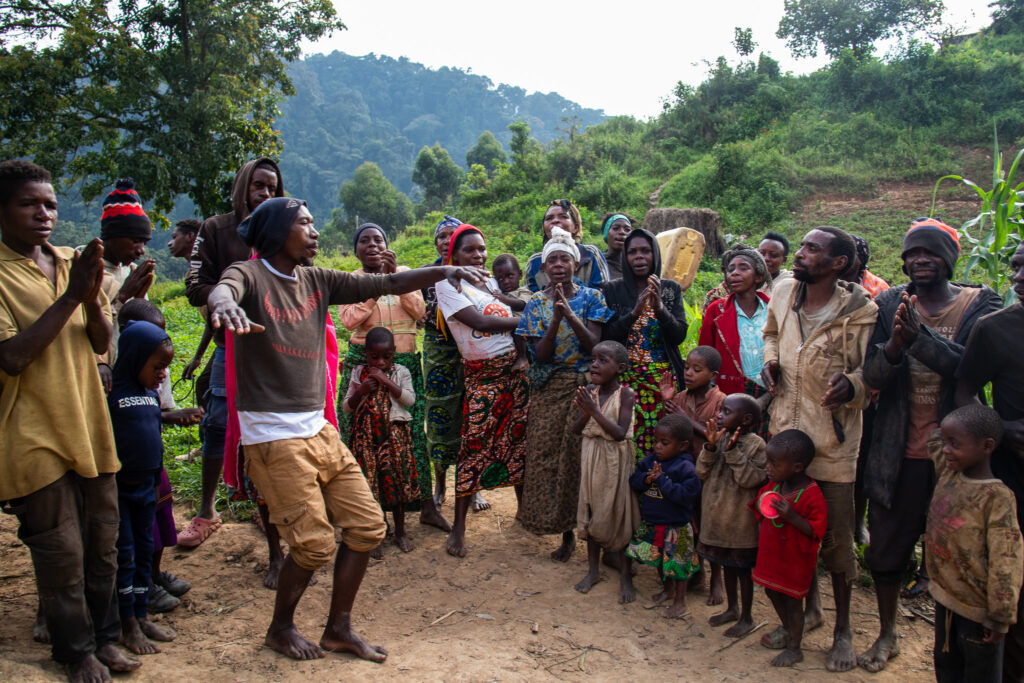
Visiting the Batwa Community The trek to the Batwa village was challenging, steep, winding, and unforgiving, but the landscape was breathtaking. When we arrived, the village was quiet. Not everyone was there, only those who did not work that day and the younger children. Others were away, earning what they could. We brought posho (starchy porridge) and a box of soap for the Batwa families and distributed drawstring backpacks to the children. We split the posho and soap so that each family received their share. It wasn’t much, but it was something, necessities that would help them get by a little longer. After we finished distributing everything, something surprising occurred. The whole village started to dance. It wasn’t about performance or showing off. It was their way of saying thank you, a gesture rooted in deep cultural tradition, a language of gratitude that went beyond words. They sang, moved, and smiled, and during those moments, joy filled a space usually marked by hardship. Later, I sat with the Batwa leader. He shared stories I will never forget.  He described life in the forest before 1991, how they moved freely, how they knew every trail and tree, and how the forest provided everything they needed. And then he told me about the day they were forced to leave.  There was no warning. Government officials arrived and told them that the forest was now protected and that they had to leave. As they walked out, they were ordered to surrender their traditional clothing and personal belongings. Everything made from the forest and everything that connected them to their identity was left behind. Those items were burned right in front of them as they left their home for the last time. In exchange, they received regular clothes and were told to start over. “We didn’t understand,” he said softly. “The forest was ours. We protected it. We lived with it, not against it. And then, suddenly, we were outsiders.” In his hands (see photo below) are the traditional fire-starting tools that sustained his ancestors for millennia. He demonstrated the technique with muscle memory still intact, sticks rubbing, friction building, and sparks emerging. Then came the matchbox and a bittersweet smile. “Now it’s easy.” Easy, yes. But something was lost in that convenience. He holds the fire-starting stick his ancestors used for generations, then smiles and pulls out a matchbox. “Now it’s easy.” This Batwa couple graciously shared their story with me, recounting their displacement from the forest and the rich life they once knew among the trees. Some of the Batwa showed me their homes. A few had built traditional houses, small structures made from natural materials, constructed the way their ancestors had. They said they couldn’t get comfortable in the concrete houses the government built. Those houses didn’t feel like home. As I left the village that day, I reflected on resilience, not the romanticized kind, but the essential kind for survival. The Batwa didn’t choose displacement. They didn’t choose poverty or marginalization. Yet, they’re still here. Still dancing and still teaching their children their tradition. Still holding onto parts of who they are, even as the world tries to erase them! This story is not about nostalgia. It is not about romantic resilience. The Batwa did not choose displacement. They did not select marginalization. Yet they continue, dancing, teaching, remembering, speaking. Listening to them is not optional. It is essential. The following day, I walked through the forest with a Batwa guide named Daniel during the Batwa Experience. They showed how their ancestors made fire, hunted, gathered medicinal plants, and built shelters. The knowledge was precise, embodied, and intensely alive. But when the tour ended, they left the forest, just like we did. The difference is, they are only allowed to enter it now as guides, not as the people who once belonged to it!  

The Batwa People Read More »

Meet Isa: Our Expert Tour Guide

Voices of the Land Beyond the Jack-of-all-Trades Isa calls himself a jack-of-all-trades, but after hearing his stories and seeing his skills firsthand, it’s clear he’s a master of many things! He manages a construction crew, leading a team of men who help build the infrastructure this community depends on. He’s an expert driver who navigated the winding, unpredictable roads of Rubuguri with calm precision, keeping me safe on every turn on terrain that would rattle most. And he’s one of our most knowledgeable tour guides, a storyteller passionate about hiking and bird watching. He has an intimate understanding of the trails, wildlife, and the forest’s rhythms. It was an honor to have met him, and I look forward to working with him on our future projects!      Isa Builder, Storyteller, Sustainable Expert Tour Guide           But what makes Isa truly remarkable isn’t just what he does; it’s what he carries. His father managed a mining team in the Bwindi Impenetrable Forest before it became a UNESCO World Heritage Site. When the forest was still contested ground, a place of labor and survival rather than protection and tourism. Through Isa, those stories live on: stories of a different era, a different relationship with the land, and the complex history that shaped this place long before the world knew its name. Isa is a father of four, deeply rooted in his community, and someone who sees Bwindi not just as a destination but as home. When he guides, he doesn’t just point out birds or name trails. He connects you to the spirit of the place, its history, its present, and the people who have lived here for generations. Traveling with Isa is to see Uganda through the eyes of someone who entirely belongs to it. And to realize that the best guides aren’t those who have studied a place from the outside, but those who have built their lives in it.         

Meet Isa: Our Expert Tour Guide Read More »

Meet Gloria: A Future Leader

Success Stories Leading the Next Generation When I visited Rushaga Community School to give gifts to the children, I met Gloria. It was evident from the moment I met her how much she cares for every child there. Her compassion comes naturally, but her determination to create change goes well beyond that. Gloria’s own journey began at this very school. Coming from a challenging home life, she has six siblings, and her father left. Her mother left as well, taking three of the children, leaving Gloria to care for three other siblings. Gloria’s path could have been defined by hardship. But thanks to Happy Bruno’s sponsorship of her education, she was able to rise above her circumstances.   Gloria A Sustainable Tourism Ambassador          Education didn’t just change Gloria’s life; it ignited a purpose in her. Now, she carries the responsibility of her family on her shoulders while also nurturing the next generation. She cares not only for her younger siblings and grandparents but also for the community’s children, determined that they will have a brighter future. What makes Gloria extraordinary isn’t just her resilience; it’s how she chooses to use it. She deeply understands what it means to grow up in these villages, face obstacles that seem impossible, and need someone who believes in her. Now, she’s becoming that person for others. As an expert tour guide for our partnership, Gloria brings something irreplaceable: an authentic connection. She doesn’t just know the trails and the wildlife; she knows the stories behind every village, the struggles of every family, the dreams of every child. When she speaks about this community, she speaks from lived experience. When she advocates for change, it’s personal. Gloria never left Rushaga. After finishing school she returned to her community, working at Nshong Camp as a guide and assistant while continuing to support the children at Rushaga Community School.  “She is multi-faceted, deeply rooted, and full of potential. I am honored to be her mentor.” A photo with Gloria, her sister, and grandmother when I visited their home.

Meet Gloria: A Future Leader Read More »

Meet Chef Benny: Our Head Chef

Success Stories A Taste of Resilience One of my favorite stories from Rushaga Community School is that of Chef Benny Alex, a man whose journey from humble beginnings to Head Chef is inspiring and heartwarming. Raised by a single mother in the Rushaga community, Benny was encouraged by teachers at a young age to pursue a path as either a doctor or a chef. He chose the kitchen, letting that vision carry him through the daily challenges of life as he dreamed of achieving culinary greatness.     Chef Benny Head Chef          I had the distinct pleasure of having Chef Benny serve as my personal chef during my time in Rubuguri. I am grateful that I got to know him personally, as he shared his incredible story with me in between preparing my meals. After finishing his introductory courses at Rushaga Community School, Benny followed his dream at Kabale University, earning a degree in Hospitality Management and Catering. With limited resources, his mother worked tirelessly to help pay for tuition, yet books and other essentials remained out of reach. Benny refused to let that stop him. He sold bricks to cover the costs and make his dream come true. In 2018, Benny started his career at a lodge owned by an Italian company. They provided him with 8 months of on-the-job training before promoting him to a full-time chef and, eventually, to head chef, a role he still holds today. He works during the high season and receives an allowance in the low season, which gives him the flexibility to take leave when needed. This is Chef Benny turning constraints into cuisine. With a basic kitchen and limited supplies, he’s rolling out my favorite breakfast, Rolex!   During my visit in the slow season, it was clear from the very first meal that I was in capable hands. His skill, care, and precision were evident in every dish, and he looked after me until my very last day in Uganda by preparing packed breakfasts and lunches. Benny’s dedication to me goes beyond cooking; he was incredibly meticulous about food safety, ensuring he used bottled water for my juices and salads. He is a master of the Rolex, my favorite, the traditional Ugandan chapati soaked in an omelet and rolled with tomatoes and peppers, which was easily the best I’ve had. He always made sure I was well-fed and received the most significant portions, such as the giant lamb skewer he prepared before I left Rubuguri. Benny is also a dedicated father to two children, a 12-year-old son and a 6-month-old daughter. Despite his achievements, he stays humble, kind, and deeply connected to his community, an example of the resilience and spirit fostered by Rushaga Community School. Benny’s story is a reminder that dreams can grow from the humblest beginnings and, with determination, hard work, and a little creativity, flourish into a life that inspires others. Please help us change their story. Support the Rushaga Community School Initiative!       Chef Benny made sure I got the best piece. This lamb skewer was more than a meal—it was generosity, skill, and the kind of care you don’t forget! A farewell celebration with my Ugandan family, hosted by the Bruno Family. They sent me off with lamb, laughter, and love! The kind of goodbye that stays with you long after you’ve left!

Meet Chef Benny: Our Head Chef Read More »

Meet Gloria: Community Leader and Women’s Advocate

The Architects of Rubuguri Creating Space for Women to Rise Every strong community has women who quietly and consistently keep it together. Gloria is one of those women. Gloria and her husband, Happy, were both born in Rubuguri. Like many young people seeking opportunity, they moved to Kampala, where they attended university and started building their lives. But when their first son was born, they made a decision that would shape not only their family’s future but also that of an entire community. They decided to return home.   Gloria B. Community Leader and Women’s Empowerment Advocate        Once a week, Gloria brings these women together! They weave baskets. They chat. They sing. They dance. It looks like an afternoon gathering, but it’s actually something bigger—a space where women reclaim their voice, their skills, and their power. Returning wasn’t just about geography. It was about responsibility, belonging, and choosing service over comfort. When I met Gloria, she was five weeks away from giving birth, yet she kept showing up week after week for the women of Rubuguri. Through her work with the villages, she teaches women how to sew and, more importantly, how to build independence and confidence through their own skills. Gloria holds weekly gatherings with women from various villages, creating a safe and empowering space. They weave baskets, share stories, laugh freely, and support each other. And then, almost always, they sing and dance, grounding their work in joy, culture, and connection. What Gloria is building goes far beyond just income generation. She is fostering community, dignity, and belief—proof that empowerment doesn’t always come from speeches or funding but from showing women what they are capable of. Seeing her work reveals that actual change can appear subtle, but it is deeply impactful. Gloria isn’t just supporting the women of Rubuguri. She’s walking alongside them, strengthening the community from within.   These women are from a different village, but Gloria made sure they weren’t forgotten. She taught them to sew, equipping them with skills that translate to independence and income. Real empowerment means showing up—even when it’s not convenient. This is Immaculate—a woman who inherited a coffee plantation and is making it thrive. Gloria makes sure women like her are supported, connected, and empowered to succeed. In Rubuguri, women’s empowerment isn’t just talk. It’s women lifting women, one success story at a time!

Meet Gloria: Community Leader and Women’s Advocate Read More »

Scroll to Top