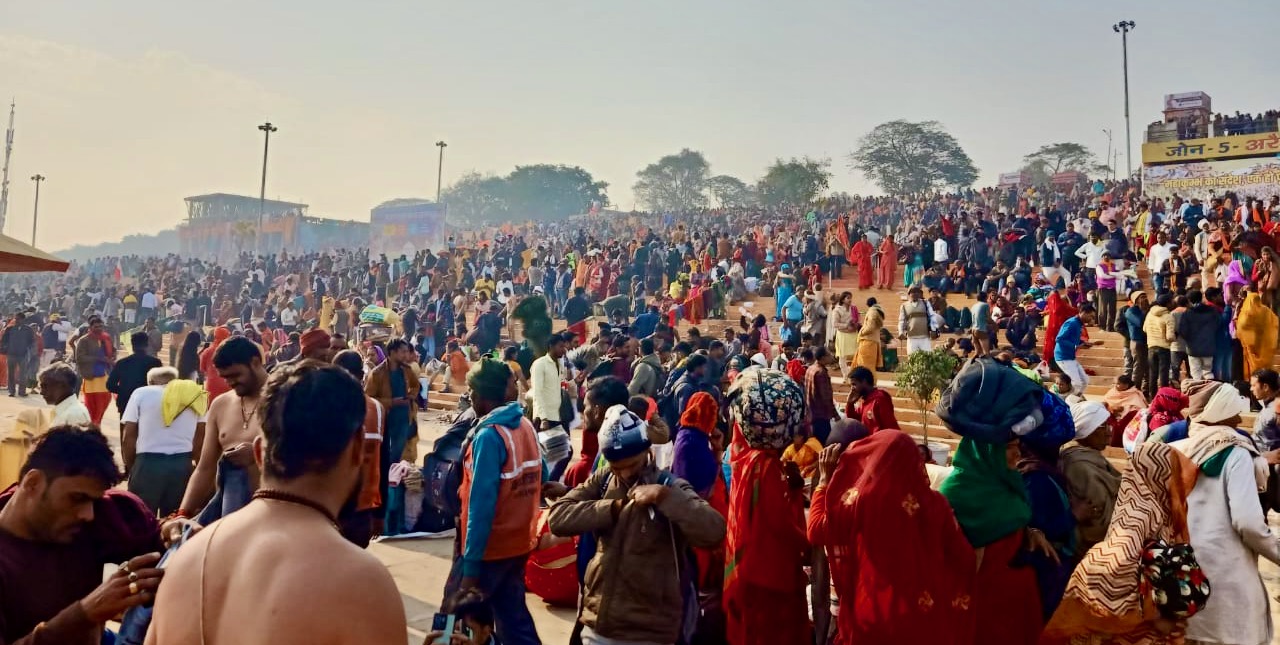
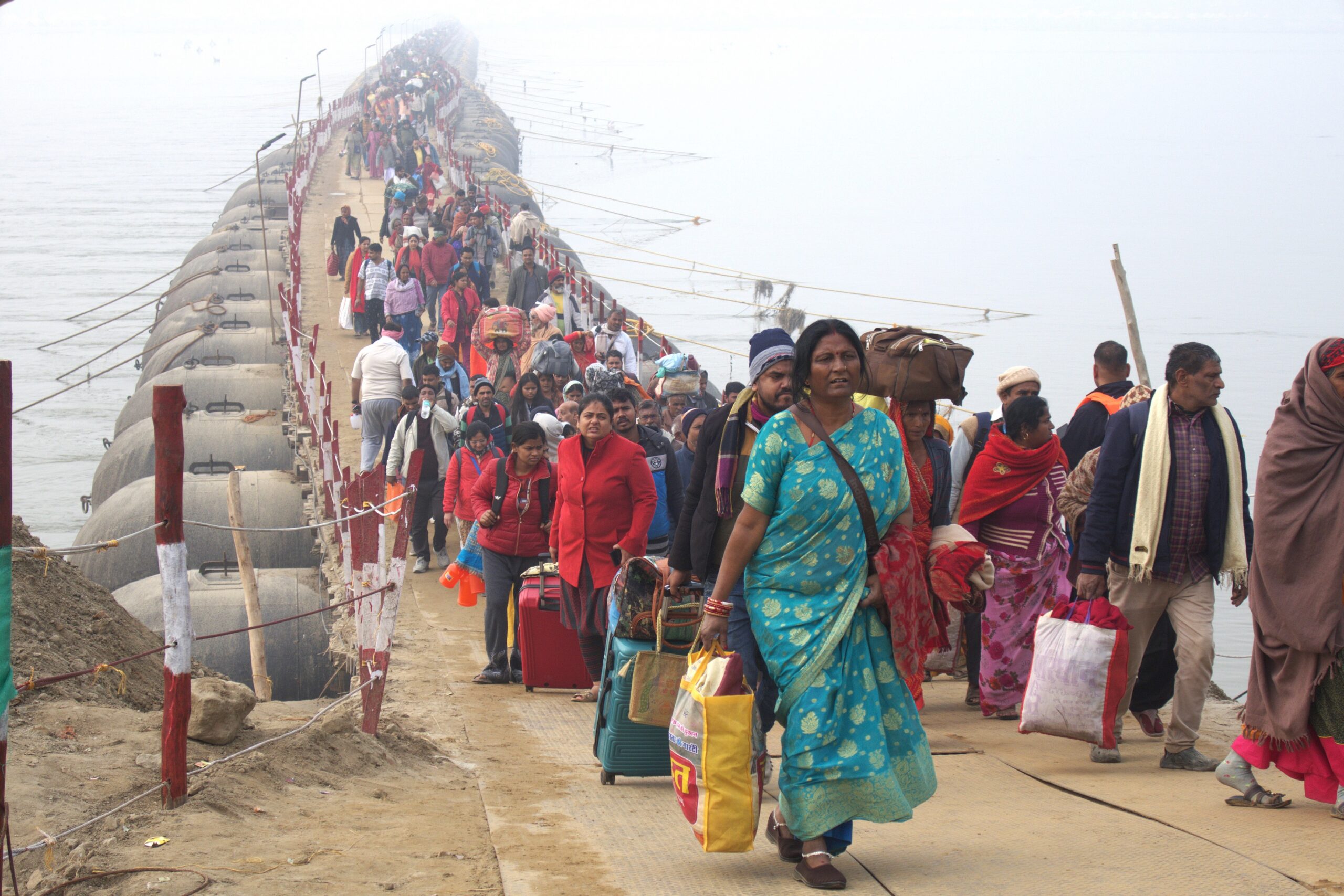
For six weeks in early 2025, Prayagraj, India, held more people than most countries do. Between January 13 and February 26, an estimated 660 million pilgrims passed through a temporary city of tents, pontoon bridges, and floodlit avenues built on the sandbanks where the Ganges and Yamuna rivers meet. It was the Maha Kumbh Mela, by most measures, the largest single gathering of human beings in recorded history.
What “Kumbh Mela” Means
The name comes from two Sanskrit words: kumbh, meaning pot or pitcher, and mela, meaning fair or festival. Together they refer to a vessel from Hindu mythology said to hold amrita, the nectar of immortality. The festival itself is a rotating pilgrimage, held in turn at four river cities, Prayagraj, Haridwar, Ujjain, and Nashik, on a cycle tied to the positions of Jupiter and the sun. A standard Kumbh Mela occurs roughly every twelve years at each site. The “Maha” (great) Kumbh is rarer still: it follows a planetary alignment that recurs only once every 144 years, which is why the 2025 gathering at Prayagraj carried extra weight for the millions who traveled to it.
A Myth of Cosmic Struggle
The festival’s origin story is drawn from the Samudra Manthan, the churning of the cosmic ocean. According to the legend, gods and demons briefly joined forces to churn the sea of milk in search of the nectar of immortality, using a mountain as a churning rod and a giant serpent as the rope. When the nectar finally surfaced, a struggle broke out over who would drink it. During the chase that followed, four drops are said to have fallen to earth, at Prayagraj, Haridwar, Ujjain, and Nashik. Each site is believed to have absorbed a measure of that immortal power, which is why bathing there is considered spiritually potent, and why the festival returns to each city in rotation.

Why Prayagraj
Prayagraj holds particular significance because it sits at the Sangam, the confluence of three rivers: the Ganges, the Yamuna, and the Saraswati. The last one is believed to flow on a purely spiritual plane, invisible to the eye. Hindu tradition holds that bathing where three sacred rivers meet multiplies the purifying power of the water many times over. That belief is what pulls pilgrims into the river at dawn, often in near-freezing temperatures, to wash away accumulated karma.
Timing Written in the Stars
Bathing dates aren’t arbitrary. They’re set by ancient astronomical calculations tracing back to the Vedic era, matching specific alignments of the sun and Jupiter. The most significant of these is Amrit Snan (the “nectar bath”), and in 2025 the single largest bathing day was Mauni Amavasya, the new-moon day in late January, when tens of millions entered the water within hours of one another.
A Procession of Ascetics
Each major bathing day opens with a procession of religious orders, or akharas, entering the water in a set sequence. Leading the way are typically the Naga sadhus, the ash-covered renunciants, some unclothed even in winter, who have given up material possessions entirely. Behind them come other orders of monks, mendicants, and teachers representing centuries of India’s philosophical traditions, each group taking its turn at the water before the general crowd follows.

A City Built to Disappear
What makes the Kumbh Mela remarkable isn’t only its spiritual weight but its scale as a piece of temporary infrastructure. For the 2025 event, authorities laid out thousands of acres of grounds with roads, electricity, pontoon bridges, medical stations, and sanitation systems built to serve a population larger than most nations, all of it dismantled once the festival ends. The Uttar Pradesh government reportedly committed roughly $870 million toward preparations, underscoring how a festival rooted in millennia-old scripture now runs on modern logistics, satellite crowd-monitoring, and digital registration.
The scale came with real risk. A crowd crush during the Mauni Amavasya bathing rush killed dozens of pilgrims, a sober reminder that even the most organized version of this ancient event is, at its core, an uncontainable expression of faith by hundreds of millions of ordinary people.

A Living Tradition
For all its size, the Kumbh Mela endures because of something simple: an enormous number of individuals, from wandering ascetics to first-time visitors, choosing to walk into cold river water because their grandparents did, and their grandparents before them. It is equal parts mythology, astronomy, logistics, and personal devotion — and it remains one of the clearest windows into how faith and tradition continue to shape daily life in India today.
We traveled to Prayagraj for the Maha Kumbh Mela. It was one of the most spiritual experiences of our lives. This is where our story begins.