
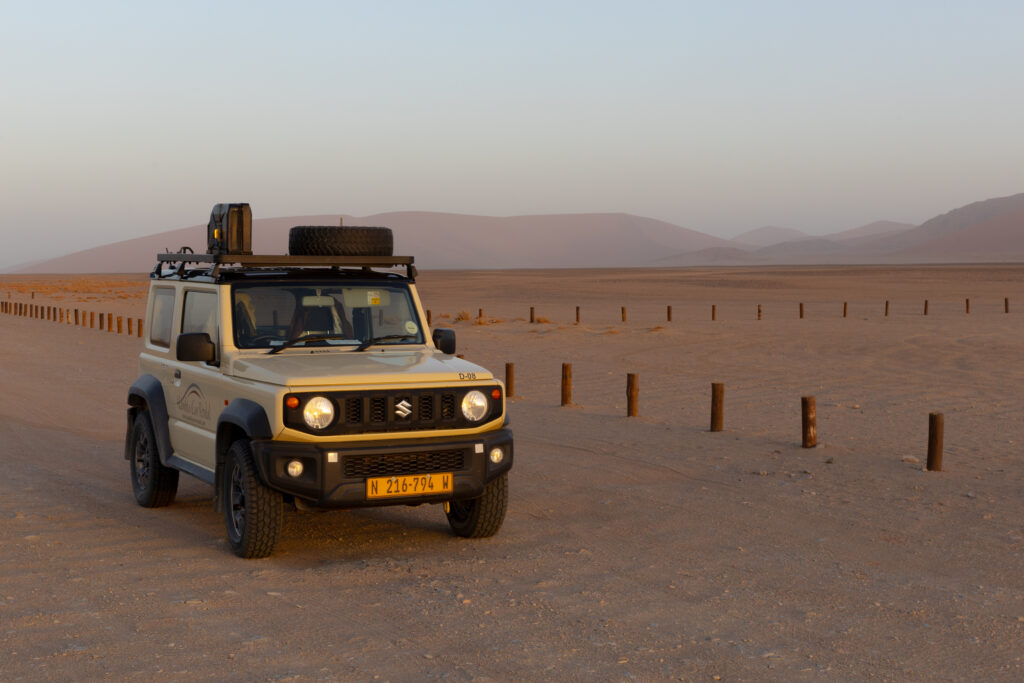
The Adventure of a Lifetime: Navigating Namibia in a Jimny
Namibia is a land of incredible contrasts, from towering dunes to rugged mountain ranges, vast savannah plains to dramatic coastlines. It is a land of breathtaking natural beauty and diverse wildlife. However, it can be challenging, especially for travelers whose idea of a vacation is dashing from one sight to another or those who need regular fixes of bustling cityscapes or fast-paced sightseeing tours. Namibia demands patience; it is a sparsely populated country. We encounter long stretches of road with nothing in sight and little or no service. It is imperative to plan your route, carry enough fuel, have plenty of water and snacks, and prepare for the considerable distances between towns. Our road trip in Namibia involved many rough, unpaved gravel roads that required careful navigation. Take an SUV or a 4×4 to explore remote areas or tackle challenging terrain. We got stuck with Jimny! I was terrified to see our rental, a Suzuki Jimny, for the first time. What is this? I can’t drive this clunky Jeep-like thing! However, the other SUV choices were much larger, heavier to operate, not to mention vastly more expensive. And they told us that my 22-year-old son, Nathan, could not drive a rental in Namibia. After talking to the manager and Nathan about the Jimny, we decided I would drive it the whole time. So, I did all the driving. It was quite a bit of driving! We started the trip in Windhoek, the capital city of Namibia. Then, we drove north to Etosha National Park. Then, we drove southwest to Swakopmund on the coast, Sesriem to Sossusvlei, and Keetmanshoop before ending in Windhoek. And there were plenty of stops along the way! Namibia is home to diverse wildlife; we encountered many animals on the roads, including many exotic animals. Be cautious, particularly during dawn and dusk, when animals are more active. It is advisable not to drive when it is dark, and it is more likely than not a violation of your rental policy and insurance. Follow the rules, and you will be safe. At times, Nathan would fall asleep. He was my GPS on this road trip! I wanted him to be awake to tell me if we were close to our next exit or if I might miss it in these vast stretches of land! Occasionally, I would yell, Hey Nathan, “LOOK, a different kind of nothingness!” The harsh landscape would shift from barren scrubland to giant rocks that looked like God had forgotten to straighten them. But if you fly across the country, you’ll miss the charm of this place’s isolation. As our clunky Jimny navigated the unpaved gravel road, the crunching of the gravel beneath its tires created a rough and hearty noise. The suspension system was tested repeatedly as the vehicle jolted and bounced over uneven terrain in windy conditions, making the drive feel like an off-road adventure. Jimny’s engine roared with determination, powering through the difficulties in its path. I gripped the steering wheel with so much force, feeling the vibrations from the road and the sound of my pounding heart. As Jimny maneuvered through the terrain’s twists and turns, the suspension creaked and groaned, desperately adapting to the unpredictable landscape, leaving a trail of adventure behind. Jimny’s design was evident as it confidently navigated the unpaved road. The poor Jimny needed help throughout the drive, particularly on the rocky, unpaved gravel roads, where more traction would have been excellent. Namibia may not be your destination if you cannot live without an internet connection. The e-SIM we purchased did not work because our 5G data was incompatible with their 3G infrastructure—an issue that others using the same e-SIM had documented online. Even if it worked, we had a weak or no connection, especially on the road. We carried a satellite phone for emergencies. Our GPS and navigation systems were nearly useless except for our first preloaded directions of the day at our accommodations. Luckily, we packed a paper map of Namibia and planned our routes at home. The upside is that we are disconnected from the outside world, which can be a daunting experience these days! Driving etiquette and rules differ from those in the United States. They drive on the left side of the road and move to the right lane when passing. Always turn the lights on when on the road, even during the day, or you will see flashing high-beam lights from cars coming your way. I am constantly reminded of this, as I often forget to turn on the headlights! On the last stretch of the drive to Windhoek to return the car, Jimny struggles to accelerate on the mountain pass, especially on steep inclines. As I painfully try to get past the first steep incline, it quickly becomes evident that Jimny needs more power to climb the slope efficiently. The car’s speed drops significantly. What used to be a comfortable cruising pace on flat terrain now turns into a slow, arduous crawl up the steep grades. The winding road continues with tight turns and hairpin bends, and every kilometer requires me to brake and then carefully accelerate again, a task that becomes increasingly difficult for Jimny and me. The lightness of the Jimny makes it feel like we are getting blown away, and I have to drive even slower. My anxiety had built up, and my struggles were real, telling Nathan I couldn’t do this. With my heart pounding and hands sweating, I tightly gripped the steering wheel as we ascended every kilometer. When we reached the higher elevation, the fierce wind grew increasingly relentless. My panic persisted as the gust swayed and pounded our jeep. I held onto the wheel tightly, struggling to keep the jeep on course as the howling wind forced me to slow down to a crawl. There is nothing I can do at this point but to press on. I know I can! And I am determined to make it past the summit. The
The Adventure of a Lifetime: Navigating Namibia in a Jimny Read More »